
Juvenile Release Destinations
A Newport News Juvenile Secure Detention Center exit is controlled by juvenile law and the responsible court. Possible outcomes include release to an authorized parent or guardian, placement under community supervision, placement directed by the court, or transfer within the juvenile justice system. The public cannot assume that leaving the building means an unrestricted return home.
The person with lawful authority should confirm the exact plan through the assigned Juvenile Services contact, the young person's attorney, or the Juvenile and Domestic Relations District Court handling the matter. Those sources can distinguish a final release from a temporary movement, supervised placement, or transfer. Public adult custody tools are not a substitute.
Confirm a Juvenile Release
Access begins with authority, not a public name search. Parents, guardians, counsel, and other people permitted by law may receive information appropriate to their role. Other requesters may need a court order or may not be entitled to the information at all. Facility staff and the court can require proof of identity and relationship before discussing a young person.
An authorized inquiry can follow a short, private path.
- Contact the Department of Juvenile Services and be ready to establish identity and authority.
- Ask the young person's attorney about the latest court order and any release conditions.
- Contact the responsible Newport News J&DR court when counsel directs or court confirmation is needed.
- Confirm who is allowed to receive the juvenile and where any court-directed placement begins.
- Follow the agency's private instructions instead of seeking a public roster result.
A verbal plan should be read together with the operative court order. The court supplies legal authority, while Juvenile Services manages the secure-detention and reentry process within its role.
Juvenile Release Contact
The City of Newport News Department of Juvenile Services operates the secure detention center. Its official program contact material provides the facility address, phone number, and weekday hours. Calling first allows staff to explain identity checks, who may receive information, and whether the inquiry belongs with a case worker, counsel, or the court.
Newport News Juvenile Secure Detention Center
Operator: City of Newport News Department of Juvenile Services
Address:
350 25th Street
Newport News, VA 23607
Telephone: 757-926-1600
Posted city hours: Monday-Friday, 8 a.m.-5 p.m.
Those posted hours describe the city office listing. They do not promise a release hour, public waiting area, or walk-in access to a juvenile record. An authorized parent or guardian should follow the instructions given for the named case and should not infer a pickup location or time from the street address alone.
Note: Facility staff may limit what can be discussed until the caller's identity, relationship, and legal authority have been verified.
Newport News Juvenile Detention
The City's Secure Detention Center page describes temporary secure detention for pretrial and adjudicated juveniles. The facility primarily serves Newport News and Hampton. Its mission includes care in custody and community reentry, but the public description does not disclose the identity or status of any young person.
The image below is limited to facility and contact context. It does not depict or search for a juvenile.
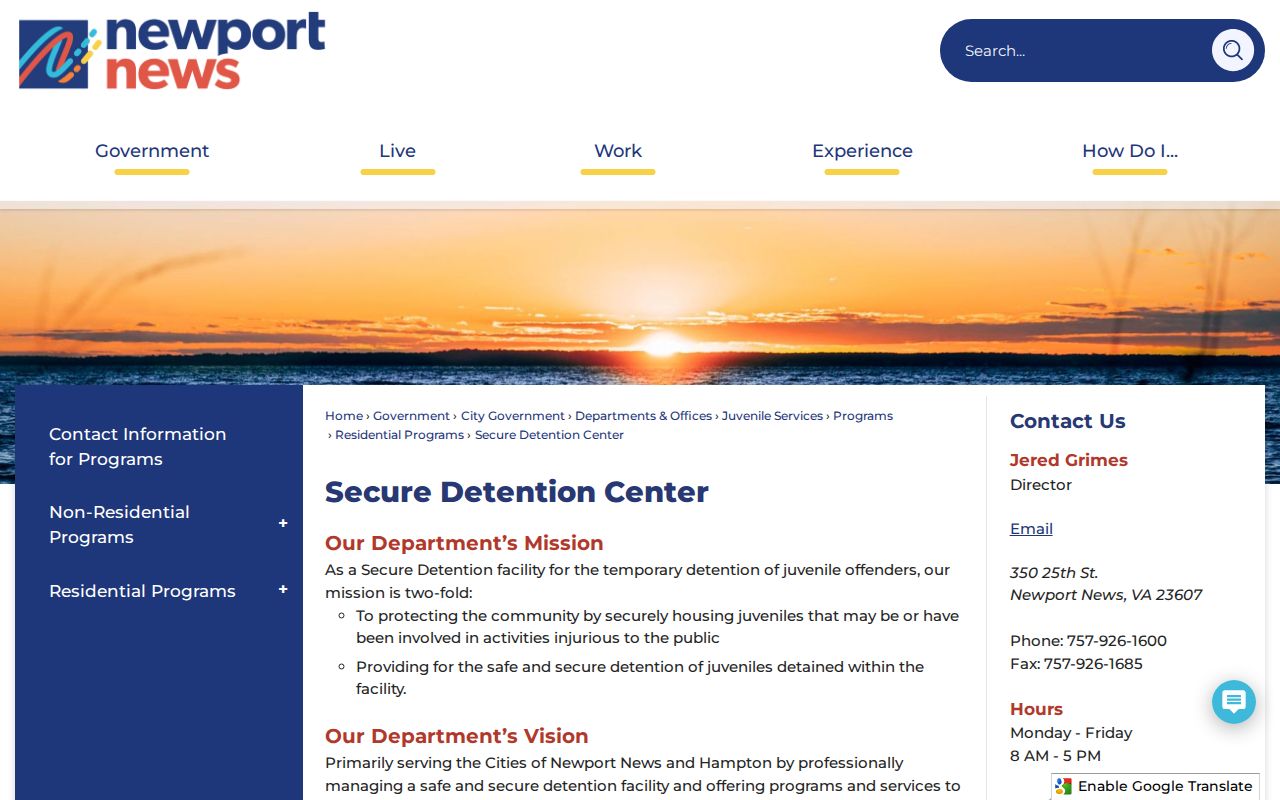
That limited use matches the confidentiality rule. Facility facts can be public even when a juvenile's case, placement, and release details are protected.
- Pretrial
- The case has not reached a final adjudication.
- Adjudicated
- The juvenile court has made a finding in the case.
- Placement
- A court-directed setting or program, which may follow secure detention.
- Community supervision
- Oversight outside secure detention under juvenile-system conditions.
Juvenile Release Record Limits
Virginia Code § 16.1-305 generally limits inspection of juvenile files to authorized people or those granted access by the court, subject to specific statutory exceptions. Juvenile hearings are also generally closed under § 16.1-302, again subject to exceptions. A limited exception does not transform the juvenile file into an adult public custody record.
The Virginia judiciary's case-search guidance states that juvenile information is unavailable online. That is why an absent public result has no useful release meaning. It is normal for confidential juvenile information not to appear. Trying alternate adult databases does not cure the access limit and risks spreading identifying details through systems that do not govern the case.
| Channel | Proper role | Access point |
|---|---|---|
| Juvenile Services | Facility and case routing for an authorized person | Identity and authority verified privately |
| Counsel | Interpret the order and advise the client or authorized family | Attorney-client process |
| J&DR court | Maintain and issue court records or orders as law permits | Clerk or court-directed request |
| Adult jail systems | No role in a confidential juvenile identity inquiry | Do not use |
Juvenile Court Release Authority
The Newport News Juvenile and Domestic Relations District Court is the relevant local court for juvenile matters. An order may authorize release to a parent or guardian, set supervision terms, direct placement, or require another step. Counsel can explain what the order requires and whether a later hearing may change it.
A court order and a physical exit are related but distinct. The order provides authority. Juvenile Services carries out the detention or placement action and can give lawful logistical instructions to an authorized recipient. If the order is unclear, counsel or the court should resolve it. Public adult criminal court searches should not be used to reconstruct the juvenile's case.
Release conditions may govern the young person's return, contact, travel, school, services, or placement, depending on the actual order. No general list can describe a named case. The authorized adult should keep the order and agency instructions together, note the responsible contact, and ask counsel about any conflict.
Juvenile Release and Reentry
The city includes community reentry in the detention center's mission. Reentry means preparation and support for the move from secure detention into a family, community, supervised program, or court-approved placement. It does not mean that all young people follow one path or receive the same release terms.
An authorized parent or guardian should confirm who will receive the young person, whether a case worker must be present, what documents are required, and where supervision or services begin. Those are case-specific logistics. Facility staff may share only what the caller is allowed to receive, while counsel can address legal obligations in the order.
Privacy remains part of safe reentry. Details about a juvenile's identity, alleged conduct, adjudication, location, or release plan should not be posted or passed through adult release-search services. A need to coordinate care does not create public access. Use direct, verified communication among the authorized family, counsel, Juvenile Services, and the responsible court.
Note: Community reentry is part of the facility mission, but it does not establish a public release date or open the juvenile file.
Adult Jail Changes Stay Separate
Newport News adult custody changed after City Farm closed in 2015 and Hampton Roads Regional Jail closed in 2024. The main City Jail and Annex now carry the city's adult jail population, and the city has discussed a future Justice Administration Complex. Those adult-system changes do not alter the Juvenile Secure Detention Center's separate operator or confidentiality rules.
The downtown facilities are physically close. The juvenile center, main jail, Annex, magistrate, and adult courts all sit in a compact area. Distance does not merge their records. The Sheriff's Office keeps adult local jail records. The Department of Juvenile Services handles juvenile secure detention, and the J&DR court controls its case records and orders.
The Newport News adult release overview applies only to adult custody. It must not be used to search for or infer the identity, placement, or release of a juvenile.
Obsolete adult regional-jail pages are therefore poor sources for any current Newport News inquiry and are wholly unsuitable for a juvenile identity. The proper path remains the private authorized chain. City planning for adult buildings does not create an adult roster entry, public release archive, or ordinary records route for a young person.