
Newport News Projected Versus Actual Release
A projected release date is the custodian's forecast based on the sentence, credit earned so far, prior jail credit, and current legal status. It can move. An actual release date records an event that has already taken place. VADOC's signed Order of Release, notification letter, or dated status entry is stronger proof than a future date shown in a locator.
Custody type comes first. The Newport News City Jail holds both people awaiting trial and sentenced people. A pretrial detainee may leave on bond, recognizance, dismissal, or another court order, but there may be no sentence-based date to calculate. A sentenced local inmate can have a date calculated under the Sheriff's written policy and Virginia law. A state-responsible prisoner can have a VADOC calculation.
Removal from the live Newport News roster also does not reveal time, reason, or destination. The person may have gone to the Jail Annex, VADOC, another jail, federal custody, immigration custody, a hospital, or the community. An executed release or transfer record resolves that question.
Find a Newport News Projected Date
The correct lookup depends on who computes the term. VADOC calculates qualifying state-responsible sentences. The Newport News Sheriff calculates applicable local sentences. A court imposes the sentence and records jail credit, but the docket's sentence length is not a substitute for the custodian's current computation.
- Check the Newport News current roster only to determine whether the person remains in City Jail or the Annex. Do not treat absence as release.
- For state custody, search the VADOC Inmate and Supervisee Locator using a VADOC ID or carefully matched name.
- Read the location and release-date information. A prison placement differs from a probation or parole district placement.
- For a local sentence, ask NNSO for the existing calculated date or time-computation record and identify the exact booking.
- Compare the court order for imposed time, suspended time, jail credit, and later amendments. Then confirm the actual event with the custodian.
The full Newport News released-inmate search path explains how to trace a person after the projected day. It joins the jail record, VADOC status, court disposition, VINE event, and any receiving custodian without assuming that one missing roster name means freedom.
Note: VADOC says its public locator is updated daily and may contain errors or dated information, so retain the current result but verify it.
Virginia Credits Shape Newport News Dates
Virginia has more than one credit system. For felonies committed on or after January 1, 1995, Virginia Code § 53.1-202.2 defines an earned sentence credit as one day deducted from confinement. The statute version effective for the calculation date controls. The offense, eligibility category, conduct level, and date all matter.
Under the version effective on the research date, § 53.1-202.3 caps listed subsection-A offenses at 4.5 credit days for each 30 days served. That framework supports the familiar rough statement that many covered sentences require about 85 percent service. Yet it is not a universal Virginia rule. Other eligible offenses use levels: 15 days per 30 at Level I, 7.5 at Level II, 3.5 at Level III, and none at Level IV.
Classification reflects program work, cooperation, infractions, and correctional adjustment. It is reviewed and may change after discipline or program events. Credits do not shorten the period required before parole eligibility. Section 53.1-189 separately addresses forfeiture and possible restoration of credits. A fixed percentage calculation performed outside the responsible agency can therefore be wrong even when the sentence length is known.
Older Good Conduct Allowance rules generally apply to pre-1995 felonies and certain older misdemeanors. Depending on class, the allowance can range from zero to 30 days per 30 served. The date of the offense and applicable statutory scheme must be checked before relying on any estimate.
Why Newport News Release Dates Change
VADOC describes each time computation as unique. The projected date can change without the original sentence being erased. Compare the current official figure with the prior result and identify the cause through the time-computation record, court order, or custody-status entry.
| Factor | Possible effect | Record to check |
|---|---|---|
| Jail credit | Earlier qualifying confinement can reduce time left. | Sentencing order and computation sheet |
| Credit level or discipline | Earning rate, forfeiture, or restoration can move the projection. | VADOC or jail time-computation record |
| Court amendment | A corrected, concurrent, or consecutive term can alter the total. | Entered court order |
| Detainer or hold | The person may transfer to another authority instead of entering the community. | Release and receiving-agency records |
| Parole action | An eligible grant can authorize conditional release; a denial can leave confinement in place. | Parole Board report and executed order |
| Calculation correction | An agency review can fix sentence or credit data. | Current official computation |
A parole vote is not an exit time. Nor does a projected date override a detainer. Keep the legal authority, the calculation, and the actual custody movement as separate facts.
Sentence structure can be especially important. Concurrent terms run together to the extent ordered, while consecutive terms run one after another. Suspended time is not active confinement unless a court later revokes it. The Virginia court docket may summarize these pieces, but the custodian's computation shows how they were applied with jail credit and statutory credits. If two official results disagree, obtain the entered orders and ask the responsible time-computation office to identify the current controlling entry.
Confirm Newport News Release Execution
Use the current projection to plan a later verification, not to announce that release occurred. For local custody, Virginia Jail VINE can report an event supplied by a participating jail. Registration before release is useful, but a VINE event still must be read closely. A transfer alert can mean movement to VADOC, another jail, a hospital, USMS, or ICE rather than return to the community.
For VADOC custody, the strongest documents include the notification of release letter, signed Order of Release, Conditions of Probation or Parole, and the dated release or status entry. A move in the locator to a community-supervision district supports institutional release while also showing that supervision continues. A final discharge document is needed to show that later stage.
Virginia Jail VINE and VADOC NAAVI are separate systems. Registration does not automatically follow a transfer from the Newport News jail into state custody. Use the VINELink Inmate Search for local-jail event registration and follow the distinct VADOC process when the person enters state custody.
Note: A release alert reports an agency event, while the executed order and receiving-custodian check establish what actually happened next.
Newport News Local Good Time
A short local sentence does not use the same formula as every modern state felony. Under the 2026 version of § 53.1-116, a person serving 12 months or less for misdemeanor sentences, without a mandatory minimum, can earn one day of good-conduct credit for each day served while following jail rules. The Newport News jailer must maintain a written credit policy.
A parole-eligible prisoner can earn 15 days per 30 satisfactorily served under the local framework, and the jailer may award five more days per 30 for qualifying work, classes, or local workforce activity when available. Post-1995 felony credits remain bounded by the statewide earned-sentence-credit article. Availability and eligibility must come from the actual record.
This Newport News distinction is why the phrases "half time" and "85 percent" cannot be swapped as statewide rules. One can refer to a qualifying short local misdemeanor calculation, while the other is a rough description of a capped modern felony category. Neither should be applied to a named person without the offense, sentence, credit class, and custodian's calculation.
The local rule also separates eligibility from actual credit earned. Rule compliance is part of the one-for-one misdemeanor provision, and extra work or class credit depends on qualifying activity being available. A mandatory minimum can change the analysis. Ask NNSO for the existing calculation and written policy that applies to the sentence rather than inferring the result from the maximum statutory rate.
For a parole-eligible local prisoner, the parole eligibility date and the final release date are not the same figure. Earned credits do not shorten the period required before parole eligibility, and the Virginia Parole Board still must act in an eligible case. A Board grant then needs an executed release process before it becomes proof that confinement ended.
Read the Official VADOC Computation
The official VADOC Time Computation page explains the agency variables behind a state projection.
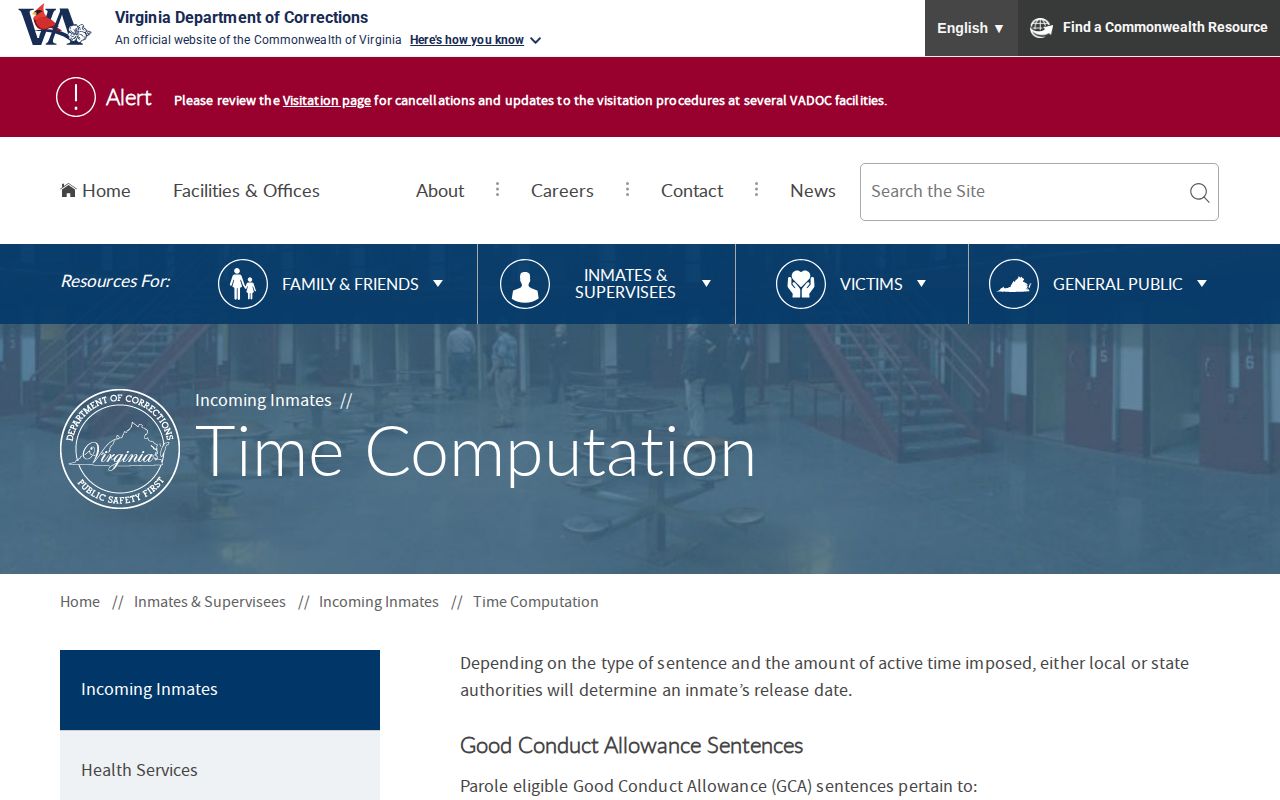
The captured source reinforces that release-date information belongs to an agency calculation, not a simple public percentage formula.
VADOC Operating Procedure 010.3 permits staff to confirm a projected release date at the time of inquiry. Ask for the current figure and note the date of confirmation. If a durable record is needed, request the time-computation entry or release documents through the agency's official records process. For a local Newport News sentence, direct the same narrow question to NNSO instead of assuming VADOC owns the calculation.
A focused VADOC request can seek the projected date confirmation, notification of release letter, signed Order of Release, release or status entry, and any transfer or detainer entry that is disclosable. Agency law allows some imprisonment records to be withheld, so ask for segregable facts rather than the entire institutional file. For NNSO, identify the booking, imposed active time, and approximate dates. Electronic production in the existing format reduces ambiguity and may keep search and duplication cost down.
After the date passes, compare the final document with the projection saved before release. A change may be valid and traceable to credits, discipline, a new order, or a hold. If the person moved to District 19, that placement supports release from prison into Newport News community supervision, not final discharge from the sentence.